
The Institute of Collaborative Innovation of the University of Macau organized the Third Macau Data Science Symposium (MSDS 2025), which was held on December 8, 2025, at the Galaxy International Convention Center in Macau. Focusing on developments in artificial intelligence (AI) and big data, the symposium aimed to promote the growth of Macau’s digital economy and the advancement of its smart city initiatives. The conference attracted over 100 participants, including experts and scholars from around the world, industry representatives, and students.
At the opening ceremony, Professor Leong Hou U, Head of the University of Macau’s Centre for Data Science, delivered welcoming remarks. He emphasized the critical function of data science and AI in advancing the digital economy, smart cities, and the modernization of social governance. He noted that the symposium seeks to strengthen academic exchange and collaboration across regions, accelerate industry–academia–research translation and application, and enable Macau to assume a more significant role in the development of the Guangdong–Hong Kong–Macau Greater Bay Area (GBA).
This year’s conference comprised three keynote speeches and seven invited talks, covering topics such as data exploration and data management, machine learning algorithms and techniques, and natural language processing, alongside practical applications across domains.
In the keynote session, Professor Zhou Aoying of East China Normal University examined the relationship between data and AI from a database perspective, arguing that modern AI is essentially “data-driven intelligence” and calling for the development of a “data power platform” analogous to an electric grid. John William Paisley, Associate Professor at Columbia University, introduced Gaussian Process Neural Additive Models (GP‑NAMs), demonstrating how supervised learning models can be made more interpretable while maintaining predictive performance. Professor Philippe Cudré-Mauroux of the University of Fribourg (Switzerland) shared an approach to building scalable technology-monitoring frameworks using eXtreme Multi-Label Classification (XMLC).
Speakers and panelists came from leading universities and research institutions worldwide, including the University of Hong Kong, Peking University, Xiamen University, Southern University of Science and Technology, Shenzhen University, the University of Science and Technology of China, and Inria (French National Institute for Research in Digital Science and Technology). Discussions spanned vector indexing and retrieval systems for foundation models, spatial data visualization, time-series anomaly detection, and retrieval-augmented generation (RAG) for large language models, showcasing cutting-edge research and underscoring the broad application of data science in marketing, smart transportation, urban governance, and AI systems.
Participants noted that Macau has distinct advantages in connecting mainland China to international research resources and advancing GBA scientific collaboration. They emphasized that sustaining high-level academic events of this kind will help enhance the University of Macau’s international profile in data science while promoting innovation, talent development, and the translation of research outcomes across the GBA.

Prof. Aoying ZHOU

Prof. John PAISLEY

Prof. Philippe CUDRE-MAUROUX

Audience listening to the talk
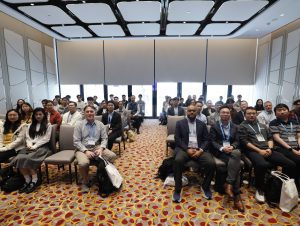
Group Photo